Conversion rate optimization is often explained as a way to “get more conversions from the same traffic.”
That framing is incomplete — and frequently misleading.
At its core, CRO is not about extracting more value from users. It is about reducing friction, improving clarity, and aligning user intent with what a digital experience actually offers. When done responsibly, CRO improves outcomes for both the user and the business. When misunderstood, it turns into pressure, manipulation, or superficial tweaks that damage trust.
This guide explains CRO as it truly functions in practice — as a user-experience and decision-clarity discipline — and places it within the broader digital marketing strategy where it belongs.
What a “Conversion” Actually Represents
A conversion is commonly defined as a completed action: a purchase, a signup, a request, a download.
But that definition only describes the visible outcome, not the underlying process.
In reality, a conversion represents successful intent alignment.
A user converts when:
- Their goal is clear
- The experience answers their questions
- The effort required feels reasonable
- The risk feels acceptable
- The next step makes sense in their context
When any of those conditions fail, conversion does not happen — not because the user was unconvinced, but because the experience did not support their decision.
CRO focuses on removing the reasons people hesitate — not creating reasons they shouldn’t.
What Conversion Rate Optimization Actually Means
Conversion rate optimization is the systematic practice of improving how clearly, reliably, and respectfully a digital experience supports user intent.
This includes:
- Making information easier to understand
- Reducing unnecessary effort or confusion
- Ensuring promises match reality
- Helping users make confident decisions
CRO does not mean:
- Convincing people who are not ready
- Pressuring users into faster decisions
- Using psychological triggers to override judgment
- Maximizing short-term metrics at the cost of trust
When optimization focuses on clarity instead of coercion, higher conversion rates are a byproduct, not the objective itself.
CRO, UX, and Persuasion: Clearing the Confusion
Many CRO resources blur important distinctions. Understanding these boundaries matters.
CRO and UX (User Experience)
UX design focuses on how an experience feels and functions overall.
CRO focuses on how well that experience supports meaningful decisions.
Good CRO depends on good UX — but UX can exist without conversion goals. CRO always asks:
Does this experience help the right users complete the right action with confidence?
CRO and Persuasion
Persuasion attempts to change behavior.
CRO attempts to remove obstacles to behavior that users already want to perform.
When persuasion techniques dominate CRO, optimization drifts into manipulation. Ethical CRO assumes:
- Users are rational enough to decide for themselves
- Hesitation often signals missing information, not resistance
- Long-term trust matters more than immediate clicks
Friction, Clarity, Relevance, and Trust
Most conversion problems fall into four interconnected categories.
Friction
Friction is unnecessary effort. It includes:
- Long or confusing forms
- Forced account creation
- Slow-loading pages
- Complex navigation
- Unclear processes
Reducing friction does not mean removing all steps. It means ensuring every step feels justified.
Clarity
Clarity answers questions before users have to ask them:
- What is this?
- Who is it for?
- What happens next?
- What does it cost?
- What are the risks?
Ambiguity kills conversion more reliably than skepticism.
Relevance
Relevance is about alignment:
- Does this page match the promise that brought the user here?
- Does the content reflect their intent, not just your offer?
CRO cannot compensate for misaligned traffic or vague positioning.
Trust
Trust is cumulative and fragile. It is built through:
- Transparent information
- Consistent messaging
- Honest constraints and limitations
- Respectful design choices
Trust cannot be forced or accelerated. CRO can only support it — or undermine it.
User Intent and Context Matter More Than Design Tweaks
A common CRO misconception is that optimization happens at the page level.
In reality, conversion is a journey-level outcome.
User intent varies by:
- Channel (search, social, email, referral)
- Device (mobile vs desktop)
- Awareness stage
- Time pressure and environment
A page that converts well for one context may fail entirely in another.
Responsible CRO starts by asking:
- Why is the user here?
- What do they expect next?
- What uncertainty are they trying to resolve?
Without intent clarity, optimization efforts become guesswork.
Why Traffic Quality Matters More Than Volume
CRO is often positioned as a fix for low conversions.
In practice, low conversion rates frequently reflect misaligned acquisition, not poor experience.
Examples:
- Informational traffic sent to transactional pages
- Broad paid traffic landing on narrow offers
- Social discovery traffic treated like high-intent search traffic
CRO cannot convert the wrong audience.
It can only help the right audience move forward more easily.
This is why CRO must be evaluated within the digital marketing ecosystem, not as a standalone tactic.
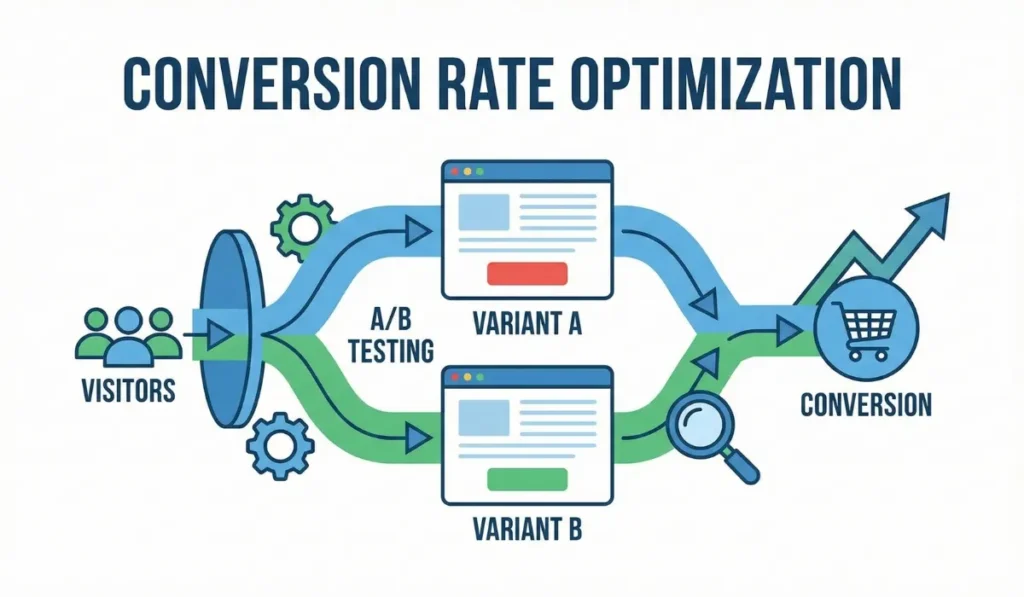
Testing as Learning, Not Validation
Experimentation is a core CRO practice — but it is often misunderstood.
Testing does not reveal universal truths.
It reveals how a specific audience responded in a specific context at a specific time.
Good experimentation:
- Generates insight, not certainty
- Explains why something may have worked
- Informs future decisions
- Accepts ambiguity
Poor experimentation:
- Seeks quick wins
- Overgeneralizes results
- Confirms existing beliefs
- Ignores external variables
A/B tests do not replace thinking. They support it.
CRO in a Modern Digital Environment (2026)
CRO today operates under constraints that older guides rarely acknowledge.
Privacy and Consent
With reduced tracking, CRO increasingly relies on:
- Aggregated data
- Qualitative feedback
- Modeled insights
- Behavioral patterns rather than individual paths
Optimization must respect consent boundaries.
Fragmented Journeys
Users move across:
- Multiple devices
- Multiple sessions
- Multiple platforms
No single page controls conversion. CRO must consider continuity and coherence across touchpoints.
Platform-Driven Traffic
Much traffic arrives through:
- Search engines
- Marketplaces
- Social platforms
Each platform shapes expectations differently. CRO must adapt to upstream context.
What CRO Can — and Cannot — Do
CRO Can:
- Reduce confusion and hesitation
- Improve decision confidence
- Surface relevant information sooner
- Support trust-building
- Improve outcomes for aligned traffic
CRO Cannot:
- Fix weak value propositions
- Compensate for poor targeting
- Overcome broken trust
- Replace product-market fit
- Guarantee growth
There are diminishing returns to optimization. At some point, improvements must come from strategy, product, or positioning — not experience refinement alone.
Common CRO Myths That Cause Harm
- “Higher conversion rates are always better”
Sometimes lower conversion reflects healthier qualification. - “Urgency converts”
Artificial urgency erodes trust faster than it increases sales. - “Small tweaks create big wins”
Meaningful improvements usually come from structural clarity, not surface changes. - “Best practices are universal”
Context matters more than patterns.
CRO as Part of a Larger System
Conversion is not a page-level event.
It is the visible result of alignment across messaging, targeting, experience, and trust.
When CRO is isolated from acquisition, positioning, and user expectations, it produces misleading results and false confidence.
When integrated thoughtfully, CRO strengthens the structure of modern digital marketing by ensuring that effort spent attracting attention is not wasted through confusion or friction.
A Clearer Way to Think About CRO
Conversion rate optimization is not about pushing users forward.
It is about removing what holds them back.
It respects user agency.
It values clarity over cleverness.
It treats conversion as a consequence of alignment, not pressure.
When viewed this way, CRO becomes less about numbers — and more about building digital experiences that deserve to convert within today’s digital marketing environment.
And that perspective is what ultimately makes optimization sustainable, ethical, and effective.