Marketing automation is often described as software that sends emails, scores leads, or triggers messages automatically. That description is not wrong—but it is incomplete in ways that matter.
In 2026, marketing automation is best understood as a systems discipline. It is the practice of designing repeatable, governed processes that help marketing teams coordinate actions across channels, time, and data constraints—while keeping humans accountable for outcomes.
This article explains marketing automation as it actually works today: imperfect, assisted by AI, constrained by privacy, and dependent on judgment. It positions automation as one layer within the Digital Marketing—specifically within the digital marketing ecosystem, where channels, signals, and decisions are interconnected rather than isolated.
Reframing Marketing Automation for 2026
Marketing automation is not a growth shortcut. It does not “run your marketing for you,” and it does not replace strategy, creativity, or responsibility.
In 2026, marketing automation means:
- Designing systems of response to customer signals
- Coordinating actions across channels and moments
- Using rules and AI assistance to reduce friction—not judgment
- Accepting uncertainty, data gaps, and limits
- Maintaining human oversight at every critical decision point
Automation today exists in a world of signal loss, fragmented identities, consent-based data, and rising expectations of relevance. As a result, automation has shifted away from volume and efficiency toward coordination, restraint, and trust.
What Marketing Automation Actually Is (and Is Not)
What it is
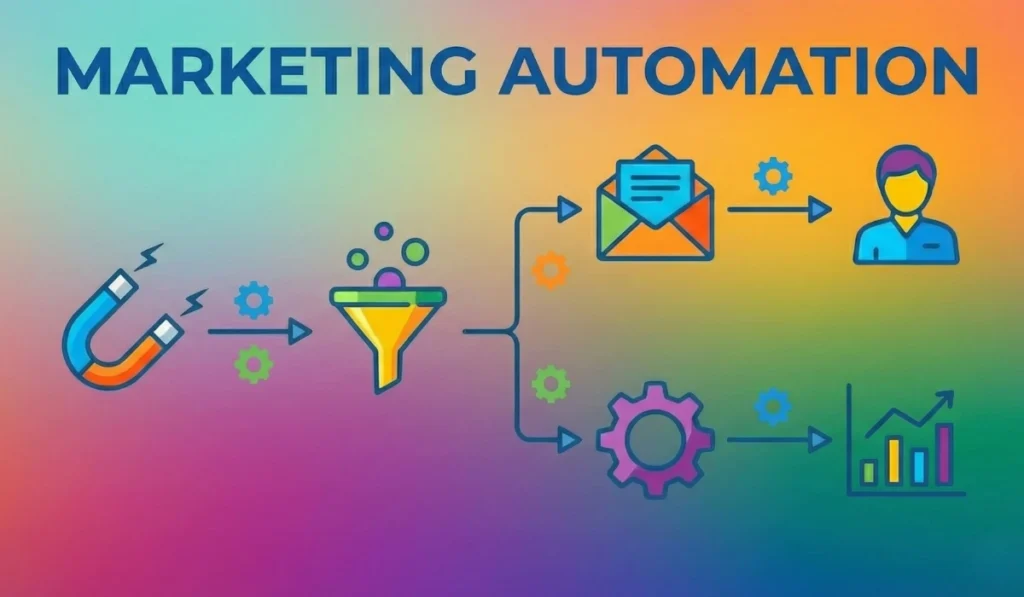
Marketing automation is the structured use of logic, triggers, and assisted decisioning to ensure that the right type of response happens consistently when specific conditions occur.
It focuses on:
- Consistency across time and teams
- Reduction of manual error and delay
- Coordination across touchpoints
- Learning from outcomes over time
At its best, automation preserves context and intent when scale would otherwise erase them.
What it is not
Marketing automation is not:
- A replacement for marketing strategy
- A way to send more messages, faster
- A “set-and-forget” growth engine
- A substitute for understanding customers
When automation is treated as a productivity hack, it tends to amplify mistakes rather than prevent them.
Automation, Workflows, Orchestration, and AI: Clearing the Confusion
These terms are often used interchangeably, but they describe different layers of the system.
Workflows
Workflows are defined sequences of actions.
Example: “If a form is submitted, send a confirmation message.”
They are deterministic and rule-based.
Automation
Automation is the umbrella discipline that includes workflows, triggers, suppression rules, and timing logic. It governs when workflows should exist and when they should not.
Orchestration
Orchestration refers to cross-channel coordination.
It ensures that messages, ads, notifications, and human follow-ups do not contradict or overwhelm each other.
AI-assisted systems
AI enhances automation by:
- Suggesting likely next-best actions
- Identifying patterns humans may miss
- Helping prioritize signals under uncertainty
AI does not replace automation logic—it augments decision quality within it.
How Marketing Automation Supports Scale—Without Shortcuts
Scale in modern marketing does not mean doing more. It means losing less context as volume increases.
Automation supports scale by:
- Preserving intent across touchpoints
- Preventing contradictory messaging
- Enforcing guardrails at speed
- Allowing humans to focus on exceptions
Without automation, growth introduces inconsistency.
With poorly designed automation, growth introduces systemic mistakes.
The goal is not speed—it is controlled responsiveness.
Signals, Triggers, Rules, and Decisions (Conceptual View)
Modern automation systems operate on four layers:
Signals
Signals are observable indicators of potential intent or change:
- Engagement patterns
- Behavioral shifts
- Timing signals
- Stated preferences
In 2026, many signals are probabilistic, not deterministic.
Triggers
Triggers define when the system should pay attention.
They are thresholds, patterns, or combinations—not single events.
Rules and constraints
Rules define:
- What is allowed
- What is suppressed
- What requires human review
Constraints matter more than triggers in modern systems.
Decisions
Decisions determine:
- Whether to act
- How to act
- Or whether not acting is the best response
Not every decision should be automated.
Human Decision-Making vs Automated Decisions
Automation handles repeatable judgment under known constraints.
Humans handle:
- Ambiguity
- Ethics
- Trade-offs
- Novel situations
In healthy systems:
- Automation proposes or executes within limits
- Humans design, review, and override
Removing humans from decision loops rarely reduces risk—it relocates it.
Where Marketing Automation Commonly Fails
Most failures are not technical. They are conceptual.
Common failure patterns include:
- Automating before understanding intent
- Over-relying on incomplete data
- Treating AI predictions as facts
- Scaling workflows that were never validated
- Ignoring long-term trust erosion
Automation magnifies assumptions. If those assumptions are weak, failure becomes systemic.
The Risk of Over-Automation and Depersonalization
Increased automation often leads to:
- Message fatigue
- Loss of relevance
- Perceived surveillance
- Brand trust erosion
Customers do not object to automation itself.
They object to automation that ignores context, consent, or restraint.
In 2026, relevance is less about personalization and more about appropriateness.
Automation Maturity Stages (Conceptual)
Most organizations progress through these stages:
- Manual coordination
Human-driven, inconsistent, fragile - Task automation
Basic workflows, limited governance - Cross-channel orchestration
Coordinated logic, shared constraints - AI-assisted decisioning
Probabilistic triggers, human oversight - Governed adaptive systems
Continuous learning with accountability
Skipping stages often creates fragile systems.
AI, Agentic Systems, and the Limits of Autonomy
AI introduces predictive triggers and adaptive logic—but also new risks.
Key distinctions:
- Rule-based automation executes known logic
- AI-assisted automation suggests likely outcomes
- Agentic systems act semi-independently
In marketing, full autonomy is rarely appropriate.
Agentic behavior without strong governance can:
- Violate consent expectations
- Create inconsistent brand behavior
- Drift from strategic intent
Responsibility does not disappear when decisions are delegated.
Marketing Automation Under Privacy and Data Constraints
Automation in 2026 operates under:
- Explicit consent requirements
- Partial identity visibility
- Modeled or inferred data
- Regulatory accountability
As a result:
- Precision is lower
- Uncertainty is higher
- Restraint is essential
Effective automation assumes data will be incomplete—and designs accordingly.
What Marketing Automation Can and Cannot Do
It can:
- Reduce coordination errors
- Enforce consistency
- Support scale responsibly
- Assist human decision-making
It cannot:
- Create demand on its own
- Replace trust-building
- Eliminate strategic trade-offs
- Remove accountability
Automation amplifies systems. It does not create them.
Marketing Automation as Part of the Larger System
Marketing automation only works when aligned with how digital marketing works as a system—where channels reinforce one another, signals are interpreted cautiously, and decisions are accountable.
Seen this way, automation is not a feature set.
It is a discipline of restraint, coordination, and learning within the wider digital marketing framework.
Final Perspective: Automation Is a Responsibility, Not a Shortcut
In 2026, marketing automation is less about doing things automatically and more about deciding what should never be automatic.
The organizations that succeed with automation are not the most aggressive. They are the most disciplined—those that design systems aligned with trust, consent, and long-term value across the broader digital marketing strategy.
Automation does not replace marketing judgment.
It reveals whether that judgment exists at all.