Local digital marketing exists at the intersection of place, intent, and trust. It is not a separate discipline from digital marketing, nor is it a shortcut to instant leads. It is a location-aware extension of the broader digital marketing ecosystem—one that helps businesses become visible when people nearby are actively looking for them.
For local businesses, visibility is not about being “everywhere online.” It is about being present, accurate, and credible in the moments that matter—when a customer’s need aligns with your location and reputation.
This article explains how local digital marketing actually works, why it succeeds or fails, and how it fits naturally into a complete digital marketing system rather than operating as a standalone tactic.
What Local Digital Marketing Really Is (And What It Is Not)
Local digital marketing is the practice of aligning your digital presence with geographic intent. It helps search engines, platforms, and users understand:
- Who you are
- What you offer
- Where you operate
- Why you can be trusted locally
What it is not:
- A set of “local SEO tricks”
- A one-time listing submission exercise
- A guaranteed lead-generation hack
- A substitute for service quality or reputation
At its core, local digital marketing answers one question consistently across the web:
Is this business relevant, nearby, and trustworthy for this user right now?
Everything else—maps, reviews, local ads, local content—is simply a supporting signal.
How Location-Based Intent Actually Works
Local searches are driven by situational intent, not curiosity.
When someone searches:
- “restaurant near me”
- “electrician in Salt Lake”
- “dentist open now”
They are not researching. They are deciding.
Location-based intent usually includes one or more of the following layers:
- Proximity: How close is the business to the user?
- Urgency: Is the need immediate or time-bound?
- Confidence: Does this business feel reliable and safe?
- Convenience: Can the user act easily—call, visit, book?
Local digital marketing succeeds when your digital signals align with these layers naturally and consistently.
Discovery: How People Find Local Businesses Online
Local discovery does not happen through one channel. It happens through overlapping touchpoints that reinforce each other.
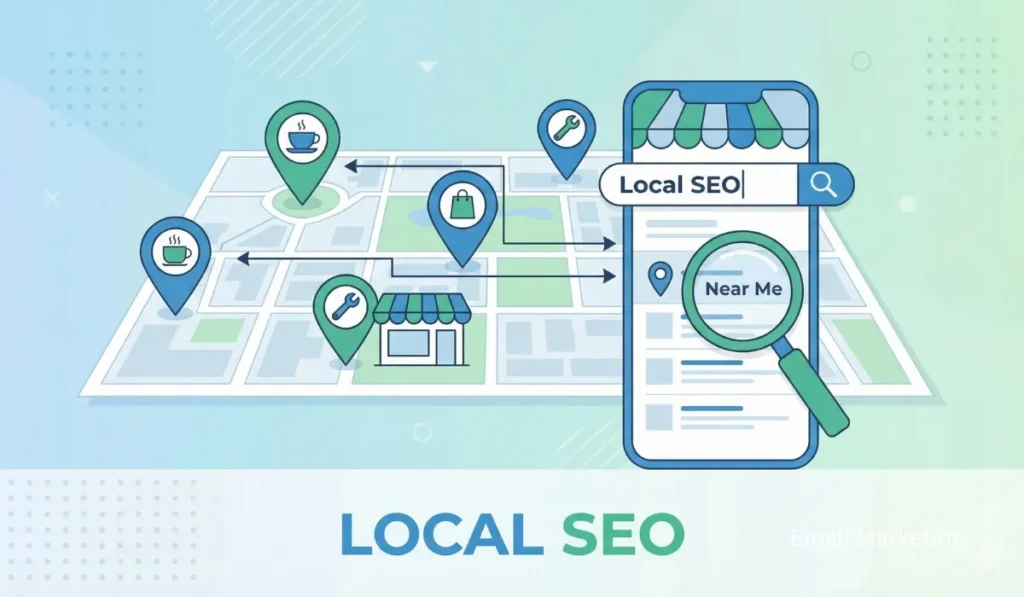
1. Maps and Local Search Results
Map-based results dominate high-intent local searches because they combine:
- Location accuracy
- Operating hours
- Reviews and ratings
- Immediate actions (call, directions)
Search engines use maps not to promote businesses—but to reduce decision friction for users.
2. Business Listings and Profiles
Listings act as identity verification systems. They help platforms confirm:
- Your address and service area
- Your business category
- Your legitimacy as a real-world entity
Inconsistencies here weaken trust—not rankings alone.
3. Organic Search with Local Context
Local organic results appear when search engines believe:
- The query has geographic relevance
- The content reflects real local expertise or presence
- The business is established in that location
Local visibility is rarely earned by keywords alone. It is earned through contextual alignment.
Trust Signals: Why Reviews and Consistency Matter More Than Tricks
Local digital marketing is fundamentally reputation-driven.
Reviews as Decision Support, Not Ranking Fuel
Reviews help users answer emotional and practical questions:
- Is this place dependable?
- Do people like me trust them?
- Are there recurring complaints?
Search engines value reviews because users do—not because of star counts, but because of patterns and credibility.
Consistency Builds Algorithmic Confidence
Consistency across your digital footprint—name, address, services, messaging—signals stability.
Inconsistency creates doubt:
- Different addresses
- Mismatched business names
- Conflicting categories or hours
Local marketing fails quietly when systems cannot trust what they see.
How Content, Ads, and Social Media Support Local Visibility
Local digital marketing is not limited to maps or listings. It is strengthened by the same pillars that support all digital marketing—when applied with location awareness.
Localized Content
Content helps establish relevance beyond listings:
- Service explanations rooted in local context
- Community-focused stories or updates
- Pages that reflect real service areas and audiences
This is not about city-name repetition. It is about demonstrating local understanding.
Paid Media with Geographic Relevance
Local ads work best when they:
- Match local intent, not generic offers
- Reinforce brand familiarity
- Support visibility during peak demand periods
Paid media supports discovery—but cannot replace trust.
Social Presence as Proof of Activity
Social platforms signal:
- Business activity
- Responsiveness
- Community engagement
For local users, social media often acts as a credibility cross-check, not a discovery engine.
Why Local Marketing Fails When Treated as a Checklist
Many local marketing efforts fail—not because platforms are unfair, but because the approach is fragmented.
Common failure patterns:
- Listing setup without ongoing accuracy
- Reviews collected but not responded to
- Content published without local relevance
- Ads run without brand or reputation support
Local digital marketing is a system, not a task list. When one part sends conflicting signals, the entire system weakens.
Common Misconceptions About Local Digital Marketing
“Local SEO is faster than digital marketing.”
Local marketing still depends on trust, time, and consistency.
“More listings mean more visibility.”
Accuracy and credibility matter more than volume.
“Reviews alone will fix everything.”
Reviews amplify reality—they do not replace it.
“Local marketing is only for small businesses.”
Any business serving defined locations depends on local signals.
Local Digital Marketing as Part of the Bigger Picture
Local digital marketing does not replace digital marketing—it completes it.
It connects:
- Brand visibility with real-world access
- Online trust with offline decisions
- Marketing systems with geographic reality
When approached correctly, local digital marketing becomes a natural extension of how digital marketing works as a system, grounded in proximity, relevance, and reputation rather than shortcuts.
Businesses that succeed locally do not chase algorithms. They align their digital presence with how real people choose nearby services—calmly, consistently, and credibly.
Final Perspective
Local digital marketing works best when it is treated as an ongoing relationship with a place, not a campaign.
It rewards businesses that:
- Show up accurately
- Serve consistently
- Communicate clearly
- Earn trust over time
When integrated thoughtfully into a broader digital marketing strategy, local visibility stops being unpredictable—and starts reflecting the real strength of the business behind it.