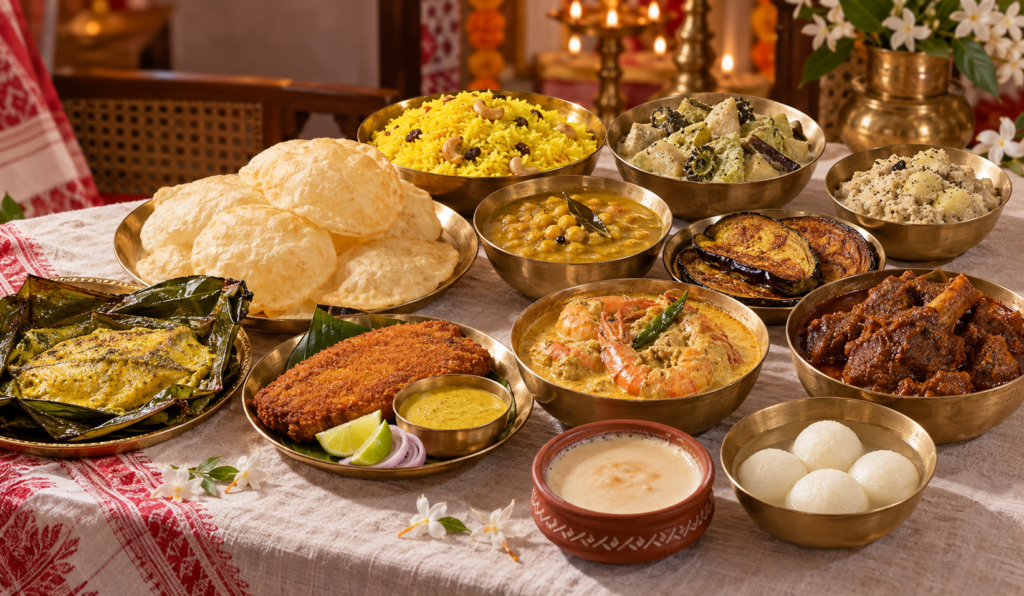
Durga Puja in Kolkata is shaped as much by food as it is by pandals, dhaak and late-night gatherings. Community bhog brings neighbourhoods together, street stalls keep pandal-hoppers moving and Bengali restaurants prepare meals suited to long festive lunches.
For visitors, the number of choices can be confusing. Trying every popular item in one day is neither comfortable nor necessary. This guide covers 12 must-try Bengali foods in Kolkata during Durga Puja, along with a few restaurants where these dishes commonly appear.
Menus and fish availability can change, particularly during the festival. Check with the restaurant before travelling for one specific preparation.
1. Bhoger khichuri
Durga Puja bhog usually centres on khichuri made with rice and lentils. It is commonly served with labra, a mixed-vegetable preparation, along with fried vegetables, chutney and payesh.
Bhog is offered to the goddess before it is distributed among devotees. It should be understood as part of the Puja ritual rather than another commercial meal.
Check the distribution time at the pandal you plan to visit. Take a reasonable portion and follow the instructions of the organisers.
2. Luchi with cholar dal or alur dom
Soft, puffed luchi with cholar dal or Bengali-style alur dom is a familiar festive combination. Cholar dal often contains coconut pieces and a mildly sweet balance of spices, while alur dom provides a richer potato-based accompaniment.
This combination works well as breakfast, an early lunch or part of a larger Bengali thali. Restaurants such as 6 Ballygunge Place include luchi, dal and vegetable preparations across their Bengali menus.
Eat it before the longest part of your pandal route. Several fried luchis followed by hours of walking may feel heavier than expected.
3. Shukto
Shukto is a mixed-vegetable preparation with a mild bitterness. Ingredients differ between kitchens, but bitter gourd, raw banana, drumstick, brinjal and other vegetables may be included.
It is usually eaten near the beginning of a traditional meal with steamed rice. Its restrained flavour provides a contrast to the fish and meat dishes that follow.
Shukto can be found at traditional Bengali restaurants, including 6 Ballygunge Place and several pice hotels. It is a useful choice for diners who want to understand Bengali cuisine beyond its well-known non-vegetarian dishes.
4. Bhetki paturi
Bhetki paturi consists of fish coated with a mustard-based mixture, wrapped in banana leaf and cooked until tender. Green chillies and mustard oil provide much of its characteristic aroma.
The banana leaf helps retain moisture while the fish cooks. Open the parcel carefully because the mustard sauce and steam remain concentrated inside.
Bhetki paturi appears on the menus of restaurants such as 6 Ballygunge Place and Bhojohori Manna. Pair it with steamed rice rather than several rich side dishes.
5. Bhapa or shorshe ilish
Hilsa has a distinctive flavour and a large number of fine bones. In bhapa ilish, the fish is steamed with mustard, green chillies and mustard oil. Shorshe ilish uses a mustard-based gravy and is usually served with rice.
Bhojohori Manna lists preparations such as Ilish Barishali and Ilish Paturi, while several Bengali restaurants offer bhapa or shorshe versions when suitable fish is available.
First-time diners should eat ilish slowly because of the bones. Availability and price can change according to season and sourcing.
6. Chingri malai curry
Chingri malai curry combines prawns with a coconut milk-based gravy. The sauce is usually mildly sweet, aromatic and less sharp than a mustard-heavy fish curry.
It pairs well with steamed rice or a light pulao. The dish is particularly useful for diners who prefer a gentler introduction to Bengali seafood.
Oh! Calcutta includes chingri preparations among its established Bengali offerings, while other restaurants may serve versions using different sizes of prawns. Ask whether the dish contains whole prawns if shells affect your dining preference.
7. Daab chingri
Daab chingri is prepared with prawns, coconut and spices, traditionally presented or cooked in a tender coconut shell. The flavour depends on the balance between coconut, mustard and green chilli.
The dish is richer than many everyday fish curries, so it is better shared as part of a complete meal. Oh! Calcutta and several established Bengali restaurants are associated with daab chingri preparations.
Order it with rice and one vegetable dish instead of combining it with several other coconut-based curries.
8. Kochu pata diye chingri
This preparation combines prawns with kochu pata, or colocasia leaves. The leaves require correct preparation, and the finished dish has a texture and flavour quite different from chingri malai curry.
Kasturi is widely associated with Kochupata Diye Chingri Bhapa, which appears as a signature preparation on its menu. It reflects the East Bengali influence found across many Kolkata kitchens.
The dish suits diners looking beyond the most frequently recommended ilish and malai curry options.
9. Pabda tel jhal
Pabda is a delicate freshwater fish that works well in light mustard-based gravies. In tel jhal, mustard oil, green chillies and spices create a thin but pronounced sauce.
The fish is soft and needs careful handling while eating. Steamed rice is the most suitable accompaniment because it absorbs the gravy without competing with its flavour.
For those following a Salt Lake pandal route, Devi Chowdhurani in Sector V lists Pabda Tel Jhal among its Bengali fish preparations. This makes it one of several possible dining stops in eastern Kolkata.
10. Kosha mangsho with basanti pulao or luchi
Kosha mangsho is a slow-cooked mutton preparation with a thick, reduced gravy. The cooking process develops a deeper flavour than a lighter pathar jhol.
It can be eaten with luchi, paratha, steamed rice or basanti pulao. Basanti pulao adds sweetness through fragrant rice, ghee, cashews and raisins, depending on the recipe.
Oh! Calcutta serves kosha mangsho, while 6 Ballygunge Place and other Bengali restaurants offer their own versions. Order it as the main dish of the meal rather than adding it after several fish courses.
11. Mutton Dak Bungalow
Mutton Dak Bungalow is associated with the colonial-era rest houses known as dak bungalows. Modern restaurant versions usually contain mutton, potatoes and eggs cooked in a spiced gravy, although recipes vary.
Bhojohori Manna is among the Kolkata restaurant names often connected with Dak Bungalow preparations. Other Bengali restaurants may offer chicken and mutton versions.
This is a filling dish suited to lunch or an early dinner. Pair it with rice or bread and keep the rest of the order limited.
12. Mishti doi, sandesh and rasgulla
A Bengali Puja meal usually ends with something sweet. Mishti doi offers a cool, creamy finish, while sandesh has a lighter chhena-based texture. Rasgulla provides a softer, syrup-soaked alternative.
You do not need to order all three after a large meal. Choose one dessert at the restaurant and visit a sweet shop later if your pandal route allows.
Most established Bengali restaurants include at least one traditional sweet or mishti doi. Kolkata’s standalone sweet shops provide a wider choice and make it easier to take a box home.
Plan the dishes across more than one outing
Trying all 12 foods in one day would turn pandal hopping into an eating challenge. Divide them across separate routes.
One outing can focus on bhog and street-side snacks. Another can include a Bengali lunch with shukto, rice, paturi and dessert. A later dinner may centre on chingri or kosha mangsho.
Reserve tables during the busiest Puja days and confirm whether the fish preparation you want is available. Restaurant menus, portion sizes and festival service schedules can change.
The best Durga Puja food experience comes from choosing a few dishes, giving each one time and leaving enough energy for the pandals waiting outside.