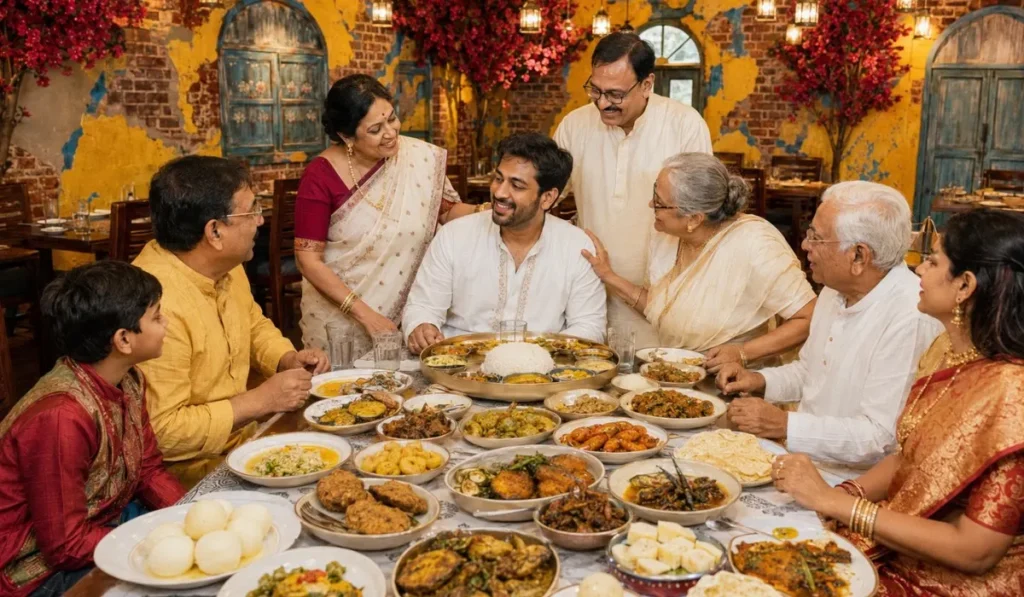
Few Bengali festivals revolve around food and family quite like Jamai Sasthi. For one special day every year, sons-in-law are welcomed like royalty, dining tables overflow with delicacies, and generations gather to keep a cherished tradition alive.
The Jamai Sasthi special thali is the centre of this celebration. It is not just a large Bengali meal. It is a plate full of blessings, family pride, affection, teasing, seasonal flavours and old customs that still matter in Bengali homes. From shukto and dal to fish fry, ilish, chingri malai curry, mutton kosha, chutney and mishti doi, every dish has a place in the story.
But why is Jamai Sasthi celebrated? Why does food matter so much? What should a traditional Jamai Sasthi thali include? What is the average Jamai Sasthi thali price in Kolkata? And where can families enjoy an authentic feast today?
Quick Answer: What is Jamai Sasthi?
Jamai Sasthi is a Bengali family festival that celebrates the bond between a son-in-law and his in-laws. Observed on Shukla Shashthi in the month of Jyaistha, the day is marked with blessings, family gatherings and an elaborate Jamai Sasthi special thali featuring rice, dal, bhaja, fish, prawns, mutton, chutney and Bengali sweets. Many families also book Bengali restaurants in Kolkata for festive Jamai Sasthi lunch or dinner.
What is Jamai Sasthi?
Jamai Sasthi, also written as Jamai Shoshthi or Jamai Shashti, is a Bengali festival dedicated to the relationship between a son-in-law and his wife’s family. In Bengali, “jamai” means son-in-law, while “Sasthi” refers to the sixth lunar day and is also associated with Goddess Sasthi, who is traditionally worshipped for the welfare of children and family prosperity.
At its simplest, Jamai Sasthi is a day when a married daughter returns to her parental home with her husband. The mother-in-law welcomes the jamai with rituals, blessings, gifts and, most memorably, a grand Bengali feast.
In many homes, the ritual begins with prayers to Goddess Sasthi. The mother-in-law may bless the son-in-law, offer fruits, sweets, new clothes or small gifts, and then serve him a carefully planned meal. The celebration is affectionate, playful and deeply emotional. The jamai may be the formal focus, but the day is also about the daughter coming home, grandchildren receiving blessings, elders gathering together and the family reconnecting over food.
For Bengalis, Jamai Sasthi is not treated like a formal religious ceremony alone. It feels personal. It belongs to the dining room, the kitchen, the fish market, the laughter around the table and that familiar line every Bengali has heard during a feast: “আরেকটু নাও” — take a little more.
That is why the Bengali Jamai Sasthi thali has become such an important part of the festival. It carries the emotion of the day in a way that words rarely can.
History and Origin of Jamai Sasthi
The history of Jamai Sasthi comes from a mix of religious belief, folk stories and Bengali family customs. Like many old traditions, it was not created in one moment. It grew slowly through household rituals, oral stories and social needs.
The religious connection is with Goddess Sasthi, a motherly goddess associated with children, fertility, protection and family well-being. In Bengal, Sasthi puja has long been observed by mothers praying for their children’s health and prosperity. Over time, this worship became connected with the married daughter’s family life, her husband and their future generations.
A popular folk story often linked with the festival speaks of a woman who secretly ate food in the household and blamed a cat. In Bengali belief, the cat is considered the vehicle of Goddess Sasthi. Angered by the false blame, the goddess punished the woman by taking away her children. The woman later realised her mistake, worshipped Goddess Sasthi sincerely, and received her children back. The story is retold in different ways across Bengal, but the moral remains similar: respect the goddess, protect family bonds and honour motherhood.
There is also a social explanation behind Jamai Sasthi. In earlier times, daughters often married into households far from their parental homes. Travel was difficult, communication was limited, and parents could not meet their daughters frequently. A fixed festival day gave the daughter a recognised occasion to visit her parents with her husband.
Feeding the son-in-law well also had social importance. It helped maintain warm relations between two families and symbolically ensured that the daughter’s married life remained respected and cared for. The son-in-law was pampered not merely as an individual, but as part of the daughter’s new household.
Over time, Jamai Sasthi became less about social obligation and more about affection. The old anxieties may have faded, but the emotional structure remains. The daughter comes home. The jamai is welcomed. The family eats together. The meal becomes a reminder that Bengali traditions often survive through taste, memory and repetition.
Why is Jamai Sasthi Celebrated?
Jamai Sasthi is celebrated for three main reasons: family bonding, blessings and tradition.
First, it strengthens the relationship between the daughter’s parental family and her married family. The son-in-law is welcomed with affection, and the daughter’s return to her maayer bari becomes a meaningful part of the celebration.
Second, the festival is connected with blessings. Mothers pray to Goddess Sasthi for the well-being of their children, grandchildren and family. The ritual may vary from one household to another, but the intention remains rooted in care.
Third, Jamai Sasthi preserves Bengali family traditions. In a time when many families live in apartments, work long hours and depend on restaurants for festival meals, the day still brings people together around a familiar idea: food is one of the deepest languages of love.
That is why the festival Jamai Sasthi continues to matter. It is not about the son-in-law eating the most expensive dish on the menu. It is about being welcomed, fed and remembered.
Why Food is the Heart of Jamai Sasthi
Food is not a side element of Jamai Sasthi. It is the emotional centre of the festival.
In Bengali homes, feeding someone properly is a serious expression of care. A festival meal is never only about hunger. It is about planning, status, seasonal produce, family pride and memory. On Jamai Sasthi, all of this becomes even more visible.
The day often begins at the fish market. Someone wants the best ilish. Someone else insists on golda chingri. Bhetki is checked carefully for fish fry. Mutton is bought early so it can be slow-cooked properly. In the kitchen, mustard oil heats up, spices are ground, vegetables are chopped, and the first smell of bhaja spreads through the house.
A traditional Jamai Sasthi meal usually follows a Bengali dining rhythm. It may begin with shukto, move to dal and bhaja, continue into vegetables, fish, prawns and meat, then end with chutney, papad and sweets. This sequence matters. It is what separates a true Bengali feast from a random collection of dishes.
The food also carries symbolism. Shukto cools the body in summer. Dal and bhaja bring comfort. Fish represents auspiciousness and abundance. Chingri and ilish add prestige. Mutton kosha signals celebration. Chutney refreshes the palate. Mishti doi and rosogolla close the meal with softness.
This is why Jamai Sasthi food is remembered for years. People may forget the exact gift given to the jamai, but they remember whether the ilish was good, whether the mutton was soft, whether the mishti doi was properly chilled, and whether the mother-in-law quietly added an extra piece of fish to the plate.
Traditional Jamai Sasthi Thali: What Does It Include?
A traditional Jamai Sasthi thali is elaborate, balanced and deeply Bengali. The exact dishes may change from family to family, but the structure usually includes rice, dal, vegetables, fried items, fish, prawns, meat, chutney and sweets.
| Dish | Role in the Thali | Cultural Importance |
|---|---|---|
| Steamed Rice | Main base of the meal | No Bengali festive meal feels complete without hot rice, especially when paired with dal, fish curry and mutton gravy. |
| Ghee | Served with rice or dal | Adds richness and warmth; often used in small quantities at the beginning of the meal. |
| Shukto | Bitter-sweet vegetable stew | Traditionally served early; valued for its cooling quality and classic Bengali dining sequence. |
| Moong Dal or Chholar Dal | Lentil course | A comforting home-style dish often paired with bhaja. |
| Aloo Bhaja | Crispy potato fry | Simple, nostalgic and loved across generations. |
| Beguni | Batter-fried brinjal | A festive favourite, especially when served hot and crisp. |
| Fish Fry | Starter-style fish item | Usually made with bhetki or similar fish; crisp outside, soft inside, often served with kasundi. |
| Rui Kalia | Rich rohu fish curry | A classic Bengali fish preparation with a festive gravy. |
| Chingri Malai Curry | Prawn curry with coconut | A premium dish in many Jamai Sasthi menus; creamy, aromatic and celebratory. |
| Hilsa Preparation | Ilish bhapa, shorshe ilish or ilish paturi | Considered one of Bengal’s most prestigious fish dishes. |
| Mutton Kosha | Slow-cooked mutton | Deep, spicy and rich; often one of the most anticipated dishes. |
| Chutney | Sweet-tangy palate cleanser | Usually served before dessert to refresh the palate. |
| Papad | Crisp accompaniment | Adds texture near the end of the meal. |
| Mishti Doi | Sweet curd | Cooling, creamy and deeply Bengali. |
| Rosogolla | Bengali sweet | Soft, syrupy and familiar. |
| Sandesh | Milk-based sweet | Elegant, lighter and often served with other sweets. |
A restaurant-style Jamai Sasthi thali may include all of these or offer a curated version. Premium thalis may add welcome drinks, starters, basanti pulao, bhetki paturi, golda chingri, ilish, mutton kosha and multiple sweets.
A good traditional Jamai Sasthi thali should never feel like a rushed combo meal. It should feel like a full Bengali feast served in the right order.
Most Popular Jamai Sasthi Foods in Bengal
Some foods have become strongly associated with Jamai Sasthi because they carry both flavour and emotion.
Hilsa
Ilish is one of the most cherished fish in Bengali cuisine. Its aroma is sharp, its texture is delicate, and its taste is unmistakable. On Jamai Sasthi, hilsa may appear as shorshe ilish, bhapa ilish, ilish paturi or ilish tel jhal.
Serving ilish often signals that the family has planned something special. It is not an everyday fish for most households, and its presence immediately makes the thali feel more festive.
Chingri
Chingri, especially golda chingri, is another favourite. Chingri malai curry brings sweetness, creaminess and richness to the table. The coconut-based gravy works beautifully with steamed rice, and the large prawn itself creates a sense of occasion.
For many families, a Jamai Sasthi menu without chingri feels incomplete.
Mutton Kosha
Mutton kosha is the dish that usually slows down the meal. It needs time, patience and a proper balance of spice, onion, ginger, garlic and garam masala. The gravy should be dark and thick, clinging to each piece of meat.
In many Bengali homes, mutton kosha is served after fish. By then, everyone is already full, but no one refuses it.
Fish Fry
Bhetki fish fry is a Kolkata classic. The outside should be crisp, the fish inside should remain soft, and the kasundi should cut through the richness with mustard sharpness. It works beautifully as a starter in both home and restaurant Jamai Sasthi menus.
Seasonal Vegetables
A proper Bengali feast does not survive on fish and meat alone. Shukto, potol, posto, echor, mocha, aloo bhaja and begun bhaja add balance and depth. These dishes bring the home-style character that makes the meal feel culturally complete.
Bengali Sweets
Mishti doi, rosogolla, sandesh, payesh, rajbhog and seasonal mango sweets often appear at the end of the meal. After fish, mutton and fried items, a cold spoon of mishti doi feels almost necessary.
Sample Jamai Sasthi Menu
A Jamai Sasthi menu can be simple, traditional, premium or modern depending on the family. Here are three practical examples.
Traditional Home-Style Menu
| Course | Menu |
| Welcome | Aam panna or gondhoraj ghol |
| Beginning | Bhaat, ghee, shukto |
| Dal Course | Moong dal with aloo bhaja and beguni |
| Vegetarian Course | Aloo posto, potol dorma or echorer dalna |
| Fish Course | Rui kalia or katla kalia |
| Premium Fish Course | Shorshe ilish or chingri malai curry |
| Meat Course | Mutton kosha with steamed rice or pulao |
| Ending | Tomato-khejur chutney and papad |
| Sweets | Mishti doi, rosogolla and sandesh |
This is the kind of menu that feels closest to a Bengali household celebration. It is rich, but not showy. It gives every course its place.
Premium Restaurant Menu
| Course | Menu |
|---|---|
| Welcome Drink | Gandhoraj doi-er ghol, aam panna or seasonal sherbet |
| Starters | Fish fry, paneer tikka, echor chop or chicken kebab |
| Rice | Steamed rice, basanti pulao or gobindobhog rice |
| Dal | Mouri phoron moong dal or chholar dal |
| Vegetarian Sides | Shukto, aloo bhaja, potol preparation, posto dish |
| Fish | Rui kalia, bhetki paturi, pomfret, parshe or chitol |
| Premium Fish | Ilish, golda chingri or chingri malai curry |
| Meat | Kosha mangsho or chicken kosha |
| Dessert | Mishti doi, rosogolla, sandesh, payesh or mango dessert |
Modern Celebration Menu
For many younger families, a modern Jamai Sasthi menu is less about serving too many dishes and more about creating a balanced, festive meal that feels easy to enjoy.
- Welcome Drink:
The meal can begin with a refreshing summer drink such as aam panna, gondhoraj cooler, doi-er ghol or a light mocktail. - Starters:
Popular starter options include fish fry, chicken cutlet, paneer chop or echorer chop. These dishes feel festive without making the meal too heavy at the start. - Main Plate:
A simple main plate can include steamed rice or pulao with dal, bhaja and one well-cooked fish curry. This keeps the Bengali character of the meal intact. - Special Add-ons:
Families who want a richer spread can add chingri malai curry, ilish preparation or mutton kosha as premium festive dishes. - Dessert:
The meal can end with mishti doi, baked rosogolla, mango sandesh, payesh or another seasonal Bengali sweet. - Serving Format:
Modern celebrations often work well as curated thalis, buffet meals, pre-booked restaurant tables or home-delivered family feasts.
This style suits smaller gatherings, working families and restaurant-based celebrations. It keeps the warmth of Jamai Sasthi alive without turning the day into a long cooking responsibility.
Jamai Sasthi Menu in Bengali
Many families search for “Jamai Sasthi menu in Bengali” because Bengali names make the menu feel more authentic. Here is a helpful reference.
| Bengali Script | English Transliteration | English Meaning |
|---|---|---|
| গন্ধরাজ দইয়ের ঘোল | Gandhoraj Doi-er Ghol | Yogurt drink flavoured with gondhoraj lime |
| আম পান্না | Aam Panna | Raw mango summer cooler |
| ভাত | Bhaat | Steamed rice |
| ঘি | Ghee | Clarified butter |
| শুক্তো | Shukto | Bitter-sweet mixed vegetable stew |
| মুগ ডাল | Moong Dal | Yellow lentil preparation |
| ছোলার ডাল | Chholar Dal | Bengal gram dal |
| আলু ভাজা | Aloo Bhaja | Fried potato strips |
| বেগুনি | Beguni | Batter-fried brinjal |
| এঁচোড়ের চপ | Echorer Chop | Raw jackfruit cutlet |
| ভেটকি ফিশ ফ্রাই | Bhetki Fish Fry | Fried bhetki fish fillet |
| রুই কালিয়া | Rui Kalia | Rohu fish in rich gravy |
| কাতলা কালিয়া | Katla Kalia | Katla fish curry |
| সর্ষে ইলিশ | Shorshe Ilish | Hilsa in mustard gravy |
| ভাপা ইলিশ | Bhapa Ilish | Steamed hilsa with mustard |
| ইলিশ পাতুরি | Ilish Paturi | Hilsa wrapped and cooked in banana leaf |
| চিংড়ি মালাইকারি | Chingri Malai Curry | Prawn curry with coconut milk |
| গোলদা চিংড়ি | Golda Chingri | Giant freshwater prawn |
| মাটন কষা | Mutton Kosha | Slow-cooked spicy mutton |
| টমেটো খেজুর চাটনি | Tomato Khejur Chutney | Tomato and date chutney |
| পাঁপড় | Papad | Crisp lentil wafer |
| মিষ্টি দই | Mishti Doi | Sweetened curd |
| রসগোল্লা | Rosogolla | Syrup-soaked cottage cheese sweet |
| সন্দেশ | Sandesh | Bengali milk sweet |
| পায়েশ | Payesh | Bengali rice pudding |
Jamai Sasthi Thali Price: What to Expect?
Jamai Sasthi thali price depends on the restaurant, location, fish choice, portion style, number of courses and whether the menu includes premium dishes like ilish, golda chingri, bhetki or mutton.
In Kolkata, the price can vary widely. A simple neighbourhood thali may be affordable, while a premium Bengali restaurant or hotel menu can cost much more.
| Category | Expected Price Range Per Person | What You Usually Get |
|---|---|---|
| Budget Jamai Sasthi Thali | ₹500–₹800 | Rice, dal, bhaja, one fish or chicken item, chutney and sweet |
| Mid-Range Bengali Thali | ₹800–₹1,500 | More courses, fish fry, one fish curry, mutton or chicken, sweets |
| Premium Jamai Sasthi Special Thali | ₹1,500–₹2,800+ | Welcome drink, multiple starters, premium fish, prawns, mutton, desserts |
| Luxury or Hotel Dining | ₹2,800+ | Buffet-style spread, premium ingredients, elaborate service and ambience |
Prices can change close to the festival, especially when ilish and prawns are involved. Fish prices rise depending on season, demand and quality. A thali with rui or katla will usually cost less than one with ilish, bhetki or golda chingri.
Before booking, families should ask a few clear questions:
- Is the thali fixed or unlimited?
- Are taxes included?
- Is service charge extra?
- Which fish is included?
- Is mutton included or charged separately?
- Is pre-booking required?
- Is the same menu available for lunch and dinner?
- Are home delivery or bulk order options available?
The best Jamai Sasthi thali price is not always the cheapest one. Value depends on taste, authenticity, portion size, fish quality, service and family comfort.
Kolkata Jamai Sasthi Celebrations
Kolkata celebrates Jamai Sasthi with a mix of old rituals and new convenience.
In traditional homes, the day often begins with shopping. Fish markets get crowded. Ilish, rui, katla, bhetki and chingri are chosen with care. Sweets are bought from trusted shops. Mangoes, curd, vegetables and spices are arranged early. By late morning, the kitchen is already busy.
In many homes, the jamai arrives with the daughter and children. The mother-in-law performs the ritual, offers blessings and then begins the careful feeding. The meal may stretch for hours. Someone complains that the jamai is eating too little. Someone else jokes that he has already eaten enough for three people.
In modern Kolkata apartments, the celebration has adjusted to busy lives. Many families now perform the ritual at home and then go to a Bengali restaurant for lunch or dinner. Others order a Jamai Sasthi special menu at home so elders can celebrate without kitchen stress.
Salt Lake, New Town, South Kolkata, North Kolkata and central Kolkata all see strong demand for Jamai Sasthi thali bookings. Restaurants often create limited-period menus because families want traditional food, but they also want comfort, air-conditioning, seating and reliable service.
This is one reason the phrase “Jamai Sasthi thali restaurant” has become common in searches. Families are not only looking for information. They are actively trying to decide where to eat.
Best Place to Enjoy a Jamai Sasthi Thali in Kolkata
While many families continue to prepare elaborate meals at home, restaurant celebrations have become increasingly popular among busy urban families.
The right Jamai Sasthi restaurant should not simply serve rice and fish curry. It should understand the emotional grammar of the day. Shukto should taste familiar. Dal and bhaja should feel homely. Fish should be cooked with care. Mutton should not feel rushed. Sweets should end the meal gently. Service should be patient because Bengali family meals are never meant to be hurried.
For families looking for an authentic Bengali thali in Kolkata, Devi Chowdhurani is a suitable option to consider, especially for those around Salt Lake, Sector 5 and nearby areas. The restaurant focuses on Bengali cuisine and has featured Jamai Sasthi thali options with traditional dishes, fish choices and festive meal formats.
What makes it relevant for the occasion is the style of food. Jamai Sasthi needs rooted Bengali flavours, not a generic buffet with a few Bengali names added. Families want a meal that feels close to maayer bari, even when they are dining outside.
Devi Chowdhurani fits naturally into that need because its Bengali food format, family-friendly setting and festival-focused offerings work well for Jamai Sasthi lunch or dinner. It is a practical option for families who want tradition without the pressure of preparing a multi-course feast at home.
Why Many Families Consider Devi Chowdhurani for Jamai Sasthi
- It focuses on Bengali cuisine rather than treating the festival as a generic dining event.
- The menu style suits families looking for a traditional Jamai Sasthi thali restaurant in Kolkata.
- Fish-based dishes and Bengali thali formats match the expectations of the festival.
- The Salt Lake Sector 5 location is convenient for families from Salt Lake, New Town, Kestopur, Lake Town and nearby areas.
- The setting works for family dining, including elders, couples and children.
- Pre-booked festive meals can reduce the stress of cooking and serving at home.
- It offers a middle path between home-style Bengali food and restaurant comfort.
This recommendation is not about saying one restaurant is the only choice. Kolkata has many Bengali restaurants offering festival menus. Families should compare menu items, price, seating, reviews, distance and booking conditions before finalising.
How to Choose the Right Jamai Sasthi Restaurant
A Jamai Sasthi restaurant should be chosen with more care than a normal weekend lunch spot. The day carries emotion, and the meal needs to respect that.
1. Check Authenticity
Look for a restaurant that understands Bengali meal sequencing. A good menu should include dishes like shukto, dal, bhaja, fish, chutney and sweets, not just random Bengali items.
2. Study the Menu Variety
A proper Jamai Sasthi special menu should have a balance of vegetarian dishes, fish, prawns, meat and desserts. If the menu includes ilish, chingri, bhetki or mutton, check whether they are included in the base price or offered as upgrades.
3. Ask About Fish Quality
Fish is often the pride of the meal. Ask which fish is being served. Rui, katla, bhetki, ilish and chingri all create different price and taste expectations.
4. Confirm Portion Style
Some restaurants serve fixed thalis. Some offer buffet-style meals. Some allow refills on selected items. Clarify this in advance.
5. Check Family Seating
Jamai Sasthi is usually a family meal, not a quick individual lunch. Elders need comfortable seating, children may need space, and families may want to sit together.
6. Read Recent Reviews
Festival days can be crowded. Check recent reviews for food quality, service speed, crowd handling and reservation reliability.
7. Compare Value
Do not judge only by price. A slightly higher-priced thali with better fish, good service and authentic flavours may be better value than a cheaper rushed meal.
8. Pre-Book Early
Jamai Sasthi lunch slots often fill quickly. Book early, confirm the menu, ask about the payment policy and keep the reservation details saved.
9. Ask About Delivery or Bulk Orders
Some families prefer to perform the ritual at home and order the food separately. In that case, bulk order or home delivery options can be useful.
Modern Trends in Jamai Sasthi Celebrations
Jamai Sasthi has changed with city life, but it has not lost its warmth.
Restaurant Dining is Now Common
Earlier, many families felt that Jamai Sasthi had to be celebrated at home. Now restaurant dining is normal. Families want the full Bengali feast without exhausting the person who usually cooks.
Curated Thalis Are Popular
Instead of serving twenty dishes, many families now prefer a well-planned thali with selected items. A good thali can still feel festive if the dishes are thoughtful.
Daughters Are More Included
Traditionally, the jamai received most of the attention. Modern families increasingly treat the day as a celebration of the daughter, son-in-law, grandchildren and the entire family.
Social Media Has Changed Presentation
Families now photograph the thali, record reels, share menu cards and post celebration moments. Restaurants also design festive plates with visual appeal because presentation matters more than before.
Home Ritual and Restaurant Meal Work Together
Many families now perform the Sasthi ritual at home in the morning and go out for lunch or dinner. This keeps the cultural part intact while making the food easier to manage.
Fusion Touches Are Appearing
Some modern menus include mocktails, baked sweets, fusion starters, continental-style plating or lighter options. Traditionalists may prefer the old format, but younger diners often enjoy the variety.
The heart of the festival remains the same. The format has simply become more flexible.
Frequently Asked Questions
Jamai Sasthi is a Bengali family festival that celebrates the bond between a son-in-law and his wife’s parents. It includes rituals, blessings and an elaborate Bengali feast.
Jamai Sasthi is celebrated to strengthen family bonds, welcome the married daughter and her husband to the parental home, and seek blessings from Goddess Sasthi for family welfare.
Jamai Sasthi is observed on Shukla Shashthi in the Bengali month of Jyaistha. The exact date changes every year according to the lunar calendar.
There is no major difference. Jamai Sasthi, Jamai Shashti and Jamai Shoshthi are different spellings or pronunciations of the same Bengali festival.
A traditional Jamai Sasthi thali may include rice, ghee, shukto, dal, aloo bhaja, beguni, fish fry, rui kalia, chingri malai curry, ilish, mutton kosha, chutney, papad, mishti doi, rosogolla and sandesh.
A Jamai Sasthi special menu is a festive Bengali meal curated for the occasion. It usually includes welcome drinks, starters, rice, dal, vegetables, fish, prawns, meat, chutney and sweets.
A Jamai Sasthi thali in Kolkata can range from around ₹500–₹800 for budget meals, ₹800–₹1,500 for mid-range thalis, and ₹1,500–₹2,800 or more for premium menus.
Rui, katla, bhetki, ilish and chingri are commonly served. Ilish and golda chingri are often considered premium festive choices.
Yes, mutton kosha is a popular Jamai Sasthi food item. Many families serve it after the fish course, often with rice, pulao or luchi.
Mishti doi, rosogolla, sandesh, payesh, rajbhog and seasonal mango-based sweets are commonly served.
Several Bengali restaurants in Kolkata offer Jamai Sasthi thalis. Families around Salt Lake and Sector 5 can consider Devi Chowdhurani for a traditional Bengali festival meal.
Look for authentic Bengali cuisine, good fish options, a balanced thali, comfortable family seating, clear pricing, recent reviews and pre-booking availability.
Traditionally, lunch is more common because Bengali festive meals are elaborate and slow. However, many Kolkata restaurants now offer Jamai Sasthi dinner menus for working families.
Yes. Many families now perform the ritual at home and then go to a restaurant for the meal. This is especially common in Kolkata’s urban households.
Traditionally, the jamai is the focus. Modern families often use the day to celebrate daughters, sons-in-law, daughters-in-law, grandchildren and the wider family together.
The festival is linked with Goddess Sasthi, who is associated with children’s welfare. Folk stories connect the day with family reunion, the married daughter’s return to her parental home, and blessings for her family.
There is no single best dish, but ilish, chingri malai curry, bhetki fish fry and mutton kosha are among the most loved festive items.
Some restaurants offer pre-booked thalis, bulk orders or home delivery during Jamai Sasthi. Availability depends on the restaurant and location.
Conclusion
Jamai Sasthi survives because it belongs to the dining table as much as the calendar. It is a day of blessings, jokes, old recipes, new clothes, carefully chosen fish and that familiar Bengali insistence: “আরেকটু নাও” — take a little more.
Behind every grand Jamai Sasthi thali is a simple emotion. Parents want their daughter to come home. The son-in-law is welcomed with affection. Children watch the rituals and learn how food can carry memory. A family sits together, and for a few hours, the old rhythm returns.
For families looking to enjoy the spirit of Jamai Sasthi without spending hours preparing a multi-course feast, restaurants such as Devi Chowdhurani offer an opportunity to experience authentic Bengali flavours in a festive setting. The best celebration, however, is not measured only by the number of dishes or the price of the thali. It is measured by how warmly the plate is served, how slowly the meal is eaten, and how long the family keeps talking after dessert.